
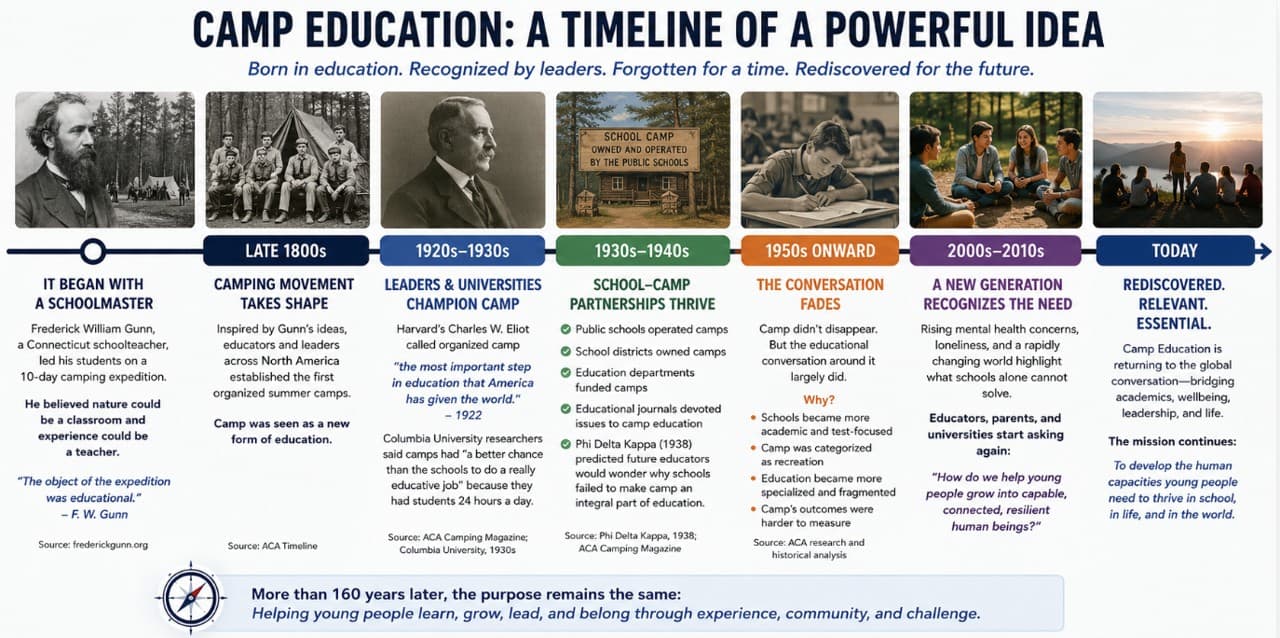
A History of Camp Education
An educational idea hiding in plain sight
Camp Education was practiced long before it had a name.
For generations, educators have observed that young people learn differently when they step outside their ordinary routines and enter an intentionally designed community. They become responsible for themselves and one another. They encounter real challenges, make meaningful choices, learn practical skills, form unusually strong relationships, and discover capacities that may remain hidden in more formal environments.
The history of Camp Education is therefore larger than the history of summer camps. It is the history of a recurring educational insight:
Children grow when experience, community, challenge, play, responsibility, and reflection are brought together with intention.
Modern organized camping provided one of the most powerful and enduring demonstrations of that idea.
"Los niños y niñas (especialmente aquellos cuyos padres no necesitaban que fueran asalariados) pasaban más tiempo que nunca en la atmósfera reglamentada del aula, sin la oportunidad de aplicar sus conocimientos de los libros al mundo real. Para los jóvenes de clase media y alta que más preocupaban a los organizadores de campamentos, las largas vacaciones de verano ofrecían una escapatoria de esta regimentación, pero un receso escolar sin relación con las tareas agrícolas era todavía un fenómeno relativamente nuevo -y preocupante- en la década de 1890. El director de campamentos Henry W. Gibson lo caracterizó como "un periodo de deterioro moral para la mayoría de los chicos... que hasta entonces habían malgastado el glorioso tiempo estival holgazaneando por las calles de la ciudad, o de forma igualmente desastrosa en hoteles de verano o lugares de diversión".
Abigail A. Van Slyck - A Manufactured Wilderness: Los campamentos de verano y la formación de la juventud estadounidense, 1890-1960
"Tengo la convicción de que unas semanas pasadas en un campamento de verano bien organizado pueden tener más valor educativo que todo un año de trabajo escolar formal".
Charles William Eliot -21º Presidente de la Universidad de Harvard
Before camp and school became opposites
Human communities have always educated young people through participation: by working alongside adults, caring for others, exploring the natural world, solving practical problems, telling stories, playing games, and gradually assuming greater responsibility.
As societies industrialized and schooling became more formal, much of that learning moved outside the recognized boundaries of education. School increasingly came to mean classrooms, academic subjects, examinations, and credentials. The other dimensions of development—independence, judgment, cooperation, physical competence, creativity, belonging, and practical responsibility—became more difficult to locate.
Organized summer camp emerged partly in response.
One widely recognized beginning occurred in 1861, when Connecticut schoolmaster Frederick William Gunn and his wife, Abigail, took their students on a two-week expedition. The students hiked to their destination, established a camp, boated, fished, explored, and lived together outdoors. The experience was successful enough that the Gunns continued it for years.
The significance of this beginning is easy to overlook: the person commonly associated with the first organized American summer camp was an educator.
Camp and school were not yet understood as opposites. Camp was an extension of education—an effort to create forms of learning that the schoolroom could not easily provide.
A response to a changing childhood
The late nineteenth century was a period of rapid urbanization, industrialization, and social change. Children were spending more time in formal schools and less time participating in the outdoor work, intergenerational community life, and practical responsibilities that had characterized many earlier childhoods.
Early camp founders responded by creating small communities in which young people could live more actively. Campers cooked, built, traveled, cared for shared spaces, learned outdoor skills, played, competed, cooperated, and contributed to the life of the group.
Some early leaders were motivated by nostalgia and by assumptions about class, race, masculinity, and social order that deserve serious scrutiny. Yet beneath those assumptions was a durable educational recognition: academic knowledge alone was not sufficient preparation for life.
In 1881, educator Ernest Balch established Camp Chocorua in New Hampshire. He envisioned a small, shared community without servants, social distinctions, or the usual comforts of privileged life. His goal was to develop responsibility, resourcefulness, independence, and democratic habits—not through lessons about those qualities, but through daily experience.
That pattern would become central to Camp Education: the environment itself became part of the teaching.
One movement, many pathways
Organized camping did not develop through a single institution or serve a single population.
Private camps were joined by programs created through the YMCA, YWCA, settlement houses, religious and cultural organizations, public agencies, youth movements, schools, and community groups. The YWCA began offering summer vacation programs for working women in the 1870s. YMCA camping expanded opportunities for boys and young men. Women educators created camps that gave girls greater physical freedom, independence, leadership, and access to the outdoors at a time when those opportunities were often restricted.
Settlement-house organizations brought children from crowded industrial neighborhoods into rural environments for recreation, health, nature study, and community living. These camps were not merely charitable vacations. They were part of a broader Progressive Era effort to reconsider the environments in which children developed and to address some of the inequalities and harms associated with urban life.
Agricultural clubs, youth organizations, Jewish community centers, faith-based programs, municipal agencies, and public schools developed additional forms of camp. Each brought different traditions and purposes, but many arrived at the same conclusion:
Young people could learn through living together in a carefully constructed community.
Camp became many things at once—a place of recreation, a setting for health and renewal, a laboratory for social development, a form of education, and, for many children, their first sustained experience of life beyond their immediate family.
Progressive education finds a living laboratory
During the early twentieth century, the emerging camp movement began to intersect more directly with progressive education.
John Dewey did not develop a theory of summer camp, and there is no strong evidence that he wrote specifically about organized camping. His educational philosophy, however, offered a powerful explanation for what camp educators were discovering in practice.
Dewey argued that education was not simply the transmission of information. Learning emerged through the interaction of the learner, the environment, other people, and meaningful activity. He emphasized experience, inquiry, play, purposeful work, reflection, and participation in democratic community.
Progressive educators recognized that camp offered unusually favorable conditions for these ideas. Camps were less constrained by examinations, rigid subject divisions, and the inherited routines of school. Activities could have immediate purposes. Young people could see the consequences of their choices. Adults could guide rather than constantly direct. The community could become both the setting and the substance of education.
The clearest direct bridge between Deweyan education and organized camping was William Heard Kilpatrick, Dewey’s colleague, student, and most influential educational interpreter at Teachers College, Columbia University.
Kilpatrick advised the Pioneer Youth Camp project and wrote introductions to two early studies of camping and education: Camping and Character in 1929 and Creative Camping in 1931. In 1942, he published The Role of Camping in Education Today, arguing that education is formed through lived experience and that camp could help advance a fuller understanding of learning.
“We learn what we live.”
— William Heard Kilpatrick, 1942
Camp was becoming more than a promising practice. It was becoming an educational proposition.
When camping became an educational field
The period from the 1920s through the 1940s produced an extraordinary body of work connecting camp, child development, progressive education, democratic living, and school reform.
Camp leaders and scholars studied campers’ experiences, group life, leadership, character, personality development, outdoor learning, and the role of the counselor. Major works included:
1929 — Camping and Character
Hedley S. Dimock and Charles E. Hendry examined camp as an environment for social and character development.
1930 — Camping and Education
Bernard S. Mason explored the educational meaning of camp from the camper’s perspective.
1930 — Education and the Summer Camp
Lloyd B. Sharp examined camp as an experiment in education.
1931 — Creative Camping
Joshua Lieberman documented a coeducational experiment in personality development and social living.
1935 — Organized Camping and Progressive Education
Carlos E. Ward connected organized camping directly to progressive educational thought.
1942 — The Role of Camping in Education Today
William Heard Kilpatrick made the case for camp within a broader conception of education.
Teachers College became an important center of this work. Its Child Development Institute published guidance for parents arguing that camps possessed unusual educational possibilities because they could shape the child’s entire social environment rather than a single class period.
Public-school systems also began experimenting with camps and outdoor education. By the 1930s and 1940s, school-camp partnerships could be found in communities across the United States. Educators asked whether camping could extend students’ experience of democratic living, deepen learning through direct experience, and become an integral part of public education.
For a period, camp stood near the center of a serious national conversation about what education could become.
The whole day became the curriculum
The educational power of camp was not located in any single activity.
Swimming did not automatically create confidence. Hiking did not automatically produce resilience. A team challenge did not automatically teach cooperation. A campfire did not automatically create belonging.
The power came from the way the experience was organized.
Camp brought together small groups, sustained relationships, meaningful rituals, graduated responsibility, contact with nature, physical movement, practical tasks, imaginative play, supported risk, reflection, and opportunities to contribute. Young people were not merely told to become responsible, resourceful, empathetic, or courageous. They repeatedly practiced those qualities in situations that mattered to them.
A meal, a disagreement, a missed goal, a rainy day, a performance, a shared cabin, a difficult climb, or an unstructured hour could all become educational experiences.
At camp, education was not confined to a lesson.
The whole day became the curriculum.
Across different traditions and program models, camps repeatedly cultivated capacities now reflected in CEI’s eight Camp Education Domains:
- Leadership and Personal Development
- Social and Emotional Learning
- Desarrollo de habilidades prácticas
- Outdoor Education and Environmental Stewardship
- Creativity and Innovation
- Physical Education and Adventure
- Health and Mindfulness
- Ciudadanía mundial
Early camp educators did not always use this language, and their aims differed across eras and institutions. But the developmental pattern is remarkably consistent.
A history to celebrate—and examine honestly
The history of organized camping should not be romanticized.
Many early camps primarily served white children from economically privileged families. Some were shaped by narrow ideas about gender, race, religion, physical ability, and what constituted an “ideal” child. Others attempted to assimilate immigrant children into dominant cultural norms.
Camp traditions also frequently borrowed names, ceremonies, clothing, stories, and symbols from Indigenous peoples without permission, accuracy, relationship, or respect. Historians have documented the use of racial stereotypes, minstrel performances, invented “tribal” identities, and romanticized portrayals of Indigenous life in camp programming. Some of these practices persisted long after their harm should have been understood.
At the same time, other camps challenged the conventions of their eras. Women founded and led institutions that expanded girls’ independence. Settlement houses created access for working-class and immigrant children. Religious and cultural communities created camps in which young people could strengthen identities often marginalized elsewhere. Some progressive camps became early sites of racial integration and more democratic community life.
To understand the history of Camp Education is to hold both realities.
Camp has demonstrated an unusual capacity to build belonging and human connection. It has also sometimes defined belonging too narrowly. The responsibility of today’s field is not to preserve every tradition, but to understand which practices truly serve children, which require transformation, and whose experiences have been missing from the story.
Expansion, professionalization, and reinvention
As camping grew, it became increasingly professional.
National associations developed standards, publications, training systems, conferences, research agendas, and accreditation processes. Resident-camp standards were followed by formal standards for day camps in the 1950s. Over time, expectations expanded beyond physical safety to include program quality, emotional safety, inclusion, staff preparation, and child development.
The camp idea also moved beyond the traditional residential summer model. It appeared in:
- Day camps
- School-year outdoor education
- Municipal and community programs
- Camps operated by schools and universities
- Medical and disability camps
- Leadership and service programs
- Arts, sports, science, and specialty camps
- International exchange and intercultural programs
By the late twentieth century, formal international collaboration among camp professionals was growing. The first International Camping Congress was held in Toronto in 1983, followed by the formation of the International Camping Fellowship and an expanding network of camp leaders across countries and cultures.
The settings, activities, and populations changed. The underlying educational method endured.
The educational language faded, but the education continued
Despite the momentum of the early twentieth century, camp gradually moved away from the center of mainstream educational thought.
Schools became increasingly associated with academic standards, testing, credentials, and institutional accountability. Camps were more often described through the language of recreation, enrichment, tourism, childcare, or the outdoors.
Camp professionals continued doing sophisticated developmental work, but the field lacked a widely shared language for explaining it. Practices were often passed from one generation of camp leaders to the next through traditions, stories, staff training, and accumulated experience.
The education remained visible in the lives of campers.
It was less visible in the way society defined education.
This created a remarkable gap: millions of children were participating in environments intentionally designed to develop human capacities, yet those environments were rarely understood as part of a coherent educational field.
The next chapter: naming Camp Education
Camp Education International did not invent the educational power of camp.
Our work begins by recognizing the educators, camp leaders, youth workers, researchers, counselors, communities, and young people who developed and refined it over more than 150 years.
What has been missing is a common structure—a way to name the field, define its methods, organize its knowledge, connect practice to research, identify its intended outcomes, and make its principles accessible across cultures and settings.
CEI is working to provide that foundation.
We define Camp Education not as a particular location, season, or type of organization, but as an educational methodology: the intentional use of experience, community, challenge, play, responsibility, and reflection to develop the whole person.
That methodology can operate in a residential camp, a day camp, a school, a community program, a sports setting, an outdoor center, or another environment designed for meaningful human growth.
The history of Camp Education began when educators first asked what children might learn if the environment around them were designed differently.
That question is more urgent now than ever.
As childhood becomes increasingly scheduled, supervised, measured, and mediated through screens, Camp Education offers something both historic and newly essential: places where young people can participate rather than merely observe, contribute rather than merely consume, and gradually become more capable through the experience of living, learning, playing, and growing with others.
Camp Education has a long history.
Its future is only beginning.